A New Laptop Category Arrives in Britain
For years, British laptop buyers have had a fairly familiar choice. Windows machines dominate the mainstream, MacBooks occupy the premium end of the market, while Chromebooks have remained popular with students, families and people who mainly need a browser and basic productivity tools.
Google now wants to make that decision more complicated.
The arrival of Googlebooks marks a significant change in the company’s approach to personal computers. Rather than positioning its new laptops as inexpensive alternatives for simple web browsing, Google is presenting Googlebook as a premium computing category designed around artificial intelligence, Android integration and more capable hardware.
The timing is particularly interesting in Britain. Googlebooks began reaching UK shelves in early October, following their initial announcement and pre-order period in September. The launch includes models from Acer, Asus, Dell, HP and Lenovo, giving consumers several different approaches to the new platform.
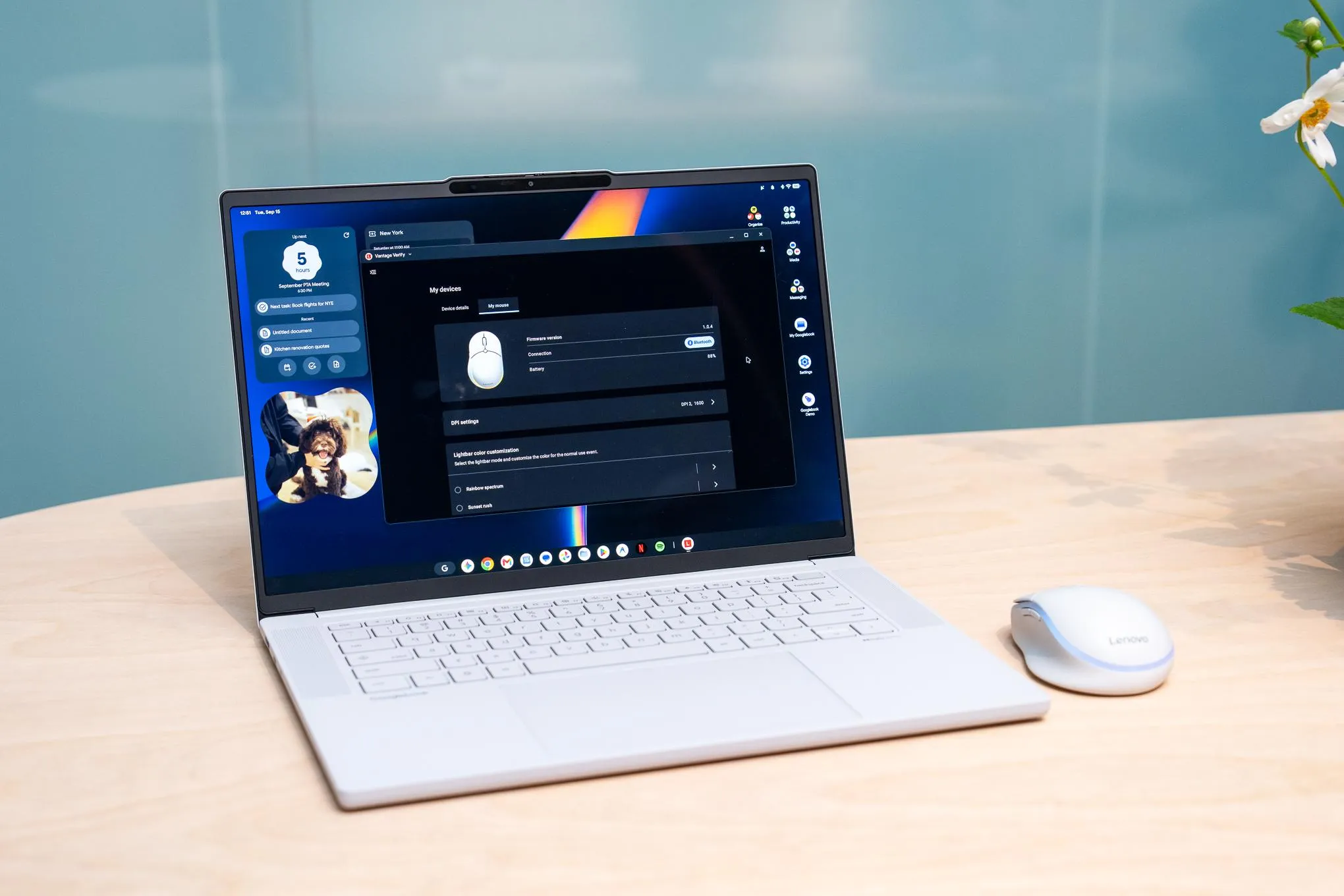
Among them, the Lenovo Googlebook 15 stands out because it takes the concept in a distinctly productivity-focused direction. It combines a large OLED display, Intel processing, a lightweight chassis and Google’s new AI-focused software experience.
That makes it much more than a traditional Chromebook with a new name.
Why the Lenovo Googlebook 15 Is Getting Attention
Lenovo’s first Googlebook is designed for people who want a larger screen without accepting the weight traditionally associated with 15-inch laptops.
The Lenovo Googlebook 15 weighs around 1.29kg and uses a 15.3-inch 2.8K OLED touchscreen with a 120Hz refresh rate and 100% DCI-P3 colour coverage. It also features up to 32GB of memory and up to 512GB of storage, depending on configuration.
For British professionals who move between home offices, cafés, trains and shared workspaces, portability could be one of its strongest selling points.
A 15-inch laptop normally suggests a machine designed to stay on a desk. Lenovo is trying to challenge that assumption. The combination of a large display and a relatively light chassis gives users more screen space for spreadsheets, documents, video editing and multitasking without making the computer feel like a traditional desktop replacement.
The screen is another major part of the appeal. OLED technology has become increasingly common in premium laptops, but its inclusion here helps position the Googlebook 15 much closer to premium Windows machines and Apple’s MacBook range than to conventional budget Chromebooks.
For British shoppers who associate Chromebooks with inexpensive plastic laptops, that difference could be crucial.
Googlebooks Are Not Simply New Chromebooks
The biggest question surrounding Googlebooks is simple: what actually separates them from Chromebooks?
The answer lies in Google’s attempt to combine the strengths of several ecosystems.
Traditional Chromebooks have generally focused on simplicity, web applications, cloud services and relatively affordable hardware. Googlebooks are designed to push considerably further, with premium displays, more powerful processors, larger memory configurations and built-in AI capabilities.
Google describes Googlebook as a premium laptop category built around Google’s software experience and Android connectivity. The company is also aiming to make the relationship between a smartphone and laptop more seamless.
That approach could resonate strongly in Britain, where Android smartphones are widely used.
Instead of treating the phone and laptop as completely separate devices, Google wants users to move between them more naturally. Files, applications and certain activities can follow users between their Android phone and computer.
For someone who spends the morning replying to messages on a smartphone, works from a laptop during the afternoon and returns to their phone in the evening, that continuity could become more valuable than raw processor performance.
Gemini Becomes Part of the Laptop Experience
Artificial intelligence is another reason Googlebooks are attracting attention.
Rather than presenting AI as an optional website or application, Google is putting Gemini Intelligence directly into the Googlebook experience.
The Lenovo Googlebook 15 supports features designed to help users write, organise information and interact with content more efficiently. Its Magic Pointer feature, for example, is designed to connect cursor actions with Gemini-powered functions. The laptop also includes Rambler, a voice-to-text feature intended to turn natural speech into more polished written content.
For British office workers, freelancers and students, these features could have practical applications.
Imagine preparing meeting notes after a long train journey. Instead of typing every sentence manually, a user could dictate ideas and allow the system to clean up filler words and formatting. A student could use AI tools while researching a presentation. A small-business owner could move from rough thoughts to a structured email more quickly.
The more interesting question is whether British consumers will actually use these features frequently.
AI has become one of the biggest selling points in technology, but buyers are increasingly asking whether an AI feature solves a real problem or simply gives manufacturers another reason to raise prices.
Googlebooks will therefore need to prove that Gemini integration is useful beyond the initial novelty.
The Battery Question Still Matters
AI performance, display quality and smartphone integration may dominate headlines, but battery life remains one of the most important considerations for anyone buying a laptop.
The Lenovo Googlebook 15 is rated for up to 12.5 hours of battery life under specified testing conditions, with a 70Wh battery. Actual results will naturally depend on screen brightness, applications, wireless connections, workload and other factors.
That distinction matters for British users.
Someone commuting between London, Manchester, Birmingham or Edinburgh may spend several hours away from a power socket. A student might move between university buildings throughout the day. A freelancer could spend an afternoon working from a café where access to charging is limited.
In those situations, battery endurance becomes part of the overall laptop experience.
As laptops become thinner and more integrated, long-term battery maintenance is also worth considering. Over several years, battery capacity naturally declines. Owners researching replacement options may eventually encounter products marketed as Lenovo laptop battery solutions for compatible Lenovo machines.
The important point is that battery life should be considered over the entire ownership period, rather than simply the first few weeks after purchase.
Can Googlebooks Challenge MacBooks?
Googlebooks are entering a market where Apple has spent years building a strong premium reputation.
The comparison is inevitable.
MacBooks benefit from Apple’s close integration between macOS, iPhone, iCloud and other devices. Googlebooks are effectively taking the opposite route: Android becomes the foundation for a laptop experience designed to connect more closely with the user’s existing Google ecosystem.
For Android users, this could be a compelling proposition.
The Lenovo Googlebook 15 also offers a large OLED touchscreen, a high refresh rate and a lightweight design. Those features give it a more premium identity than the Chromebook label might suggest.
However, Apple has a significant advantage in brand loyalty and ecosystem familiarity. Many British consumers already use iPhones, AirPods and MacBooks together, meaning that switching platforms requires more than simply comparing technical specifications.
Google’s challenge is therefore not just to build a good laptop. It has to persuade users that its ecosystem offers enough advantages to make changing habits worthwhile.
The Intel Compatibility Question
There is, however, an early issue that British buyers should keep an eye on.
The Lenovo Googlebook 15 uses an Intel Core Ultra processor, and Google has acknowledged that while most Android applications should run smoothly, some applications originally developed with Arm architecture in mind may require additional optimisation on Intel-based Googlebooks.
This does not mean that the Lenovo model is broadly incompatible with Android applications. Google says the vast majority should work properly. Nevertheless, the situation highlights a challenge created by Google’s decision to bring a mobile-oriented software ecosystem to different processor architectures.
For everyday applications, users may never notice a problem.
For specialised software, demanding games or applications that rely heavily on native components, however, compatibility could become an important consideration.
That is something the Googlebook platform will need to improve as more developers optimise their applications.
A Premium Laptop for a Changing British Workplace
The British laptop market is changing because the way people work is changing.
Hybrid working has become a permanent part of professional life for many people. Employees may spend two days in an office, two days at home and another day working from somewhere else. Students increasingly move between lecture halls, libraries and shared accommodation. Freelancers can work from almost anywhere with a reliable internet connection.
That makes flexibility more important.
A lightweight 15-inch laptop with a high-quality display could therefore make considerable sense. The Lenovo Googlebook 15 is large enough for serious productivity but light enough to carry around daily.
Its 2.8K OLED display could also appeal to creative users who want better image quality without immediately moving to a heavier workstation-class laptop.
This is where Googlebooks may have a genuine opportunity.
They do not necessarily need to replace every Windows laptop or MacBook. They only need to establish a new category for people who want premium hardware, Android connectivity and AI-powered productivity in one package.
What About Long-Term Ownership?
Price is likely to remain one of the biggest questions.
Googlebooks start at a significantly higher level than the traditional Chromebook market. The premium hardware is intentional, but British consumers are used to seeing Chromebooks as affordable machines.
The Lenovo Googlebook 15 attempts to justify its positioning through its OLED display, processing capability, AI features, lightweight construction and bundled services. It also comes with a period of Google AI Pro access for eligible buyers in the UK and several other markets.
Whether that represents good value will depend heavily on how much an individual uses those services.
For someone who lives inside Google’s ecosystem, the combination could be attractive. For a buyer who only needs email, web browsing and document editing, a cheaper Chromebook could still make more financial sense.
Long-term ownership should also include practical considerations such as charging habits, software support, storage requirements and eventual battery degradation. Searching for a Lenovo laptop battery may become part of the ownership journey years after the initial purchase, particularly for users who keep their laptops for extended periods.
A third-party replacement should always be checked carefully for compatibility, specifications and installation requirements rather than selected purely on price.
Could Googlebook Change the Way Britons Use Computers?
That may ultimately be the most interesting question.
Googlebooks are not trying to reinvent the physical laptop completely. The Lenovo Googlebook 15 still has a screen, keyboard, trackpad, ports and a conventional laptop form factor.
The bigger change is happening underneath.
Google is attempting to make the laptop more connected to the smartphone, more deeply integrated with AI and more capable of understanding what the user is doing.
If that approach succeeds, the computer could become less of an isolated machine and more of a continuation of the user’s digital life.
For British consumers, the appeal could be particularly strong among Android users who want something more premium than a traditional Chromebook without necessarily moving into Apple’s ecosystem.
At the same time, the launch is happening at a fascinating moment. AI laptops are becoming mainstream, premium OLED displays are spreading, smartphone-to-PC integration is improving and consumers are becoming more conscious of how long their devices can realistically last.
The Lenovo Googlebook 15 sits directly in the middle of all those trends.
The Start of a Bigger Experiment
The first generation of Googlebooks will not answer every question.
There will be questions about application compatibility, pricing, software maturity, AI usefulness and long-term support. There will also be comparisons with Windows laptops, MacBooks and traditional Chromebooks for years to come.
But that uncertainty is part of what makes the launch interesting.
Google has taken a familiar laptop concept and tried to rebuild it around Android, Gemini and premium hardware. Lenovo, meanwhile, has given the platform a substantial 15-inch machine aimed at people who want productivity, portability and a more immersive display.
As Googlebooks begin appearing on desks, kitchen tables, university campuses and commuter trains across Britain, consumers will decide whether this is simply another laptop format or the beginning of a different way of using personal computers.
For anyone following the UK technology market, that makes the Lenovo Googlebook 15 one of the more intriguing laptop launches of autumn 2026.
And if Google can make its software ecosystem as convincing as its hardware, the company may have found a new way to bring the Android experience beyond the phone.
For users planning to keep their machines for several years, practical maintenance will remain important too. Eventually, battery ageing can affect mobility regardless of how impressive the original specifications were. That is why the broader Lenovo laptop battery market could remain relevant even as the industry moves toward increasingly intelligent computers.
The future of personal computing may be more connected, more AI-driven and more mobile than ever. In Britain, Googlebooks are now putting that idea to the test.