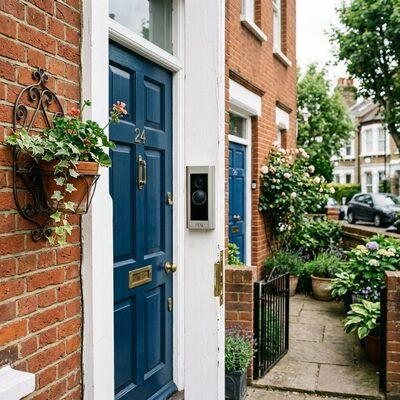
The Rise of Smart Doorbells on British Streets
Walk through almost any modern British residential neighbourhood and you are increasingly likely to spot a small camera beside someone’s front door. Smart doorbells have become a familiar feature of everyday life, particularly in suburban streets, terraced houses and apartment buildings. Products such as Amazon Ring and other video-enabled doorbells allow homeowners to see visitors, receive delivery notifications and monitor activity outside their properties, even when they are at work or on holiday.
For many households, these devices offer welcome reassurance. Package theft, unexpected visitors and concerns about burglary have encouraged more people to consider additional home security. Instead of wondering whether a parcel has arrived, residents can simply open an app and check. Some systems even allow homeowners to speak to delivery drivers remotely, making everyday deliveries more convenient.
However, the growing popularity of smart doorbells is creating an uncomfortable question: where does personal home security end and neighbourhood surveillance begin?
In Britain, where homes are often closely packed together, a camera installed above one front door may also capture a neighbour’s entrance, garden, windows or regular visitors. What one household considers sensible protection may feel intrusive to the family living next door. As a result, a seemingly harmless piece of consumer technology can become the starting point of a surprisingly serious neighbourhood disagreement.
When Home Security Becomes a Privacy Problem
The problem is particularly noticeable in traditional British terraced housing. Unlike detached properties with large front gardens, many terraced homes have entrances that face directly onto narrow pavements or shared pathways. A wide-angle doorbell camera may therefore capture considerably more than the doorstep it was installed to protect.
Imagine a family living in a residential street in Birmingham. One homeowner installs a smart doorbell after several parcels disappear from the front step. The camera records visitors approaching the property and sends instant alerts whenever movement is detected.
At first, the arrangement seems entirely reasonable. However, the neighbour soon discovers that the camera also captures people entering and leaving their own home. They begin wondering whether their daily routines, visiting friends and children’s movements are being recorded.
The disagreement may start with a simple conversation, but it can quickly become personal. One resident feels safer, while the other feels constantly watched.
This is not simply a hypothetical concern. The Information Commissioner’s Office (ICO) has previously highlighted how domestic surveillance technology can create tension between neighbours. Its research into people’s experiences of data protection found mixed reactions to smart doorbells, particularly among residents living in densely populated neighbourhoods.
The issue is not necessarily that people oppose security cameras. Rather, they want reassurance that their private lives are not being monitored without a good reason.
Britain’s Data Protection Rules: What Doorbell Owners Should Know
Smart doorbells are not exempt from privacy responsibilities simply because they are installed on private homes.
According to UK government guidance updated in May 2026, domestic CCTV rules also cover video-enabled doorbells. If a camera records only within the boundaries of the owner’s private property, data protection legislation will generally not apply in the same way.
However, the situation changes when recordings include neighbouring properties, shared spaces or public areas such as pavements and roads.
In these circumstances, the UK General Data Protection Regulation and Data Protection Act 2018 may apply. Homeowners need to consider whether their recordings are necessary, proportionate and respectful of other people’s privacy.
The ICO recommends several practical measures. Camera owners should position devices carefully, avoid recording more of the surrounding area than necessary and consider using privacy zones to block sensitive areas. They should also provide appropriate information that CCTV recording is taking place.
Importantly, homeowners should not assume that installing a camera gives them unlimited permission to record everyone passing their front door.
People captured by a camera may have rights to request access to footage containing their personal information. They may also raise objections if they believe the surveillance is excessive or unjustified.
These responsibilities are particularly relevant in Britain because a growing number of ordinary households are now operating equipment that effectively functions as a small CCTV system.
The Ring Doorbell Debate Is Becoming More Complicated
One reason the discussion has attracted attention is the popularity of Amazon Ring.
The brand has helped make smart doorbell technology familiar to mainstream consumers. Its products combine motion detection, video recording, mobile notifications and two-way communication in a relatively accessible package.
Yet the debate is no longer limited to what happens outside an individual front door.
In September 2026, The Guardian reported that Amazon planned to introduce its Ring Neighbours community app in the UK on 21 October. The service allows users to share local safety information, discuss community concerns and report issues such as suspicious activity or missing pets.
The idea has obvious appeal. Residents can exchange information about lost animals, potential thefts and other incidents without relying entirely on informal WhatsApp or Facebook groups.
Nevertheless, the expansion of neighbourhood-based security platforms raises important questions about how much information people should share about others.
A short video showing someone walking along a residential street might appear harmless to the person uploading it. But the individual being filmed may have no idea that their movements have become part of an online neighbourhood discussion.
There is also a difference between reporting a genuine security incident and encouraging residents to speculate about unfamiliar people.
For British communities, the challenge will be finding a balance between useful local information and unnecessary monitoring of everyday life.
Why Battery Life Matters More Than Many Homeowners Expect
Privacy is not the only consideration when people install smart doorbells. Practical reliability also plays an important role in the ownership experience.
Many wireless models rely on rechargeable batteries, which means homeowners need to think about charging frequency, installation position and everyday maintenance. A device that stops working because its battery has run out offers little protection when a parcel arrives unexpectedly.
The choice of a suitable video doorbell battery can therefore become an important part of the overall home security experience. Battery performance may influence how reliably a doorbell responds to motion alerts, records visitors and maintains its connection with a household’s mobile devices.
Weather conditions are another consideration in Britain. Cold winter mornings, frequent rainfall and changing outdoor temperatures can make the placement and maintenance of external electronics especially important.
A homeowner who installs a wireless doorbell in autumn may not think much about maintenance until the device begins requiring more frequent charging. Depending on the model, recording settings, motion sensitivity, Wi-Fi conditions and daily activity levels can all affect battery life.
Some households may prefer wired systems because they do not need to remove the device regularly for charging. Others appreciate wireless installation because it avoids complicated electrical work and offers more flexibility.
Neither approach automatically solves the privacy question, however. A permanently powered camera can still record too much of the surrounding neighbourhood if its viewing angle is poorly chosen.
The Hidden Problem of Audio Recording
Video footage is only part of the story. Many smart doorbells also include microphones that allow homeowners to communicate with visitors.
This feature is useful when a delivery driver arrives while nobody is home. It can also help residents speak to unexpected callers without opening the door.
However, audio recording can create additional privacy concerns.
A camera might be positioned so that it captures only a small section of the pavement, yet its microphone could potentially pick up conversations taking place nearby. Neighbours may be uncomfortable if they believe their discussions can be heard or stored by another household’s security equipment.
The distinction matters because people often notice a visible camera but may not understand exactly what its microphone can capture.
Homeowners should therefore check their device settings rather than assuming that motion detection and privacy zones automatically prevent all forms of recording.
Where possible, unnecessary audio recording should be disabled. Recording sensitivity should also be adjusted to avoid capturing conversations that have nothing to do with protecting the property.
For residents concerned about surveillance, knowing whether a device records audio continuously, only during certain events or not at all can make a considerable difference.
Can Smart Doorbells Damage Relationships Between Neighbours?
British neighbourhoods traditionally place considerable value on everyday courtesy. People may exchange greetings over garden fences, accept parcels for one another or keep an eye on a neighbour’s property during holidays.
Smart technology can strengthen this sense of community, but it can also introduce new sources of suspicion.
Consider a household that receives frequent motion notifications whenever someone walks past its front garden. The owner might begin reviewing recordings out of curiosity, even when no security incident has occurred.
Meanwhile, the neighbours may start changing their routines because they feel uncomfortable being filmed.
Neither household necessarily intends to cause trouble. The difficulty is that technology has introduced a new relationship between residents: one person controls the camera, while another may be captured by it.
This becomes particularly sensitive when children are involved. Parents may understandably object to cameras recording their children playing near their homes or walking to school.
The problem can also affect tenants living in apartment buildings, where shared entrances, corridors and communal pathways make it difficult to avoid surveillance entirely.
In these environments, clear communication is often more useful than immediately turning a disagreement into a formal complaint.
What Should Residents Do If a Neighbour’s Camera Makes Them Uncomfortable?
The first step is usually to speak directly with the camera owner.
A friendly conversation can establish what the camera actually records. Sometimes, the neighbour may not realise that their device covers another property’s entrance or part of a private garden.
Residents can explain their concerns and ask whether the camera angle, motion detection settings or privacy zones can be adjusted.
It may also help to ask the owner to demonstrate the camera’s viewing area through its mobile app. This can reveal whether the apparent surveillance is as extensive as it first seemed.
If the issue cannot be resolved informally, the ICO provides guidance on domestic CCTV and the rights of people who are recorded. Depending on the circumstances, residents may be able to make a formal data protection complaint.
Where surveillance forms part of a wider pattern of threatening or harassing behaviour, other routes of assistance may also be appropriate.
The important point is that residents do not automatically have to accept excessive surveillance simply because a camera is attached to somebody else’s property.
At the same time, homeowners should not be treated as acting unlawfully merely because a camera is visible from the street. The actual recording, its purpose and how the footage is handled all matter.
Choosing Smart Doorbells Without Creating Unnecessary Conflict
For consumers considering a new device, privacy should be part of the buying decision alongside image quality, motion detection and price.
Before purchasing, homeowners should consider whether the camera offers adjustable viewing angles, privacy masking, motion zones and clear audio controls.
It is also worth checking how recordings are stored, how long they are retained and whether additional subscription fees are required for certain features.
Battery-powered models offer convenient installation, but consumers should check charging requirements and compatibility before choosing a replacement video doorbell battery.
A device with excellent picture quality may still be unsuitable if its viewing angle makes it difficult to avoid recording neighbouring windows or entrances.
Homeowners should also consider whether they genuinely need continuous monitoring. For some properties, improved outdoor lighting, a traditional doorbell or a camera covering only the front entrance may provide sufficient reassurance without creating unnecessary privacy concerns.
The best security device is not necessarily the one that records the largest area. It is the one that addresses a genuine security need while minimising its impact on everyone else.
A New Challenge for Britain’s Connected Neighbourhoods
Smart doorbells reflect a wider change in British domestic life. More households are using connected devices to manage deliveries, monitor their properties and communicate remotely.
As these products become increasingly common, the distinction between private home security and public surveillance is becoming harder to ignore.
The arrival of neighbourhood-based security platforms adds another dimension. A recording that once remained on an individual homeowner’s phone may now become part of a wider conversation involving people living several streets away.
This does not mean Britain should abandon smart doorbells. Their practical benefits are real, particularly for people who regularly receive deliveries, live alone or want additional reassurance when away from home.
However, convenience should not come at the expense of reasonable privacy.
Ultimately, responsible ownership involves more than selecting a suitable video doorbell battery or choosing a camera with impressive technical specifications. It requires understanding what the device records, respecting the people who live nearby and being willing to adjust settings when concerns arise.
Britain’s streets may be becoming smarter, but good neighbourly relationships still depend on trust, consideration and common sense.
The next stage of smart home technology should not simply make it easier to watch our front doors. It should also make it easier for neighbours to feel comfortable living alongside one another.