When Fashion Meets the Future
Imagine putting on a jacket that changes colour when the weather turns cold, a pair of trainers that lights up in response to music, or a dress that allows you to control your smartphone simply by touching the fabric. It sounds like something taken from a science-fiction film, but interactive clothing is gradually moving closer to everyday reality.
Fashion has always reflected changes in society, technology and culture. From the arrival of synthetic fabrics to the popularity of fitness trackers and smartwatches, the clothes and accessories people choose have evolved alongside technological progress. Now, a new generation of electronic textiles could take this relationship much further by turning ordinary garments into interactive digital devices.
For the UK, where fashion, creative design and technological innovation are closely connected, this development presents an exciting opportunity. British consumers are already familiar with wearable technology, but what happens when technology is no longer something worn on the wrist or carried in a pocket? What if the clothing itself becomes the device?
Interactive fashion could change how people express themselves, communicate, exercise and even manage their daily routines. However, making these futuristic garments attractive, comfortable and practical will be just as important as developing the technology behind them.
What Exactly Is Interactive Clothing?
Interactive clothing refers to garments that contain electronic components, sensors, conductive fibres or other smart materials capable of responding to people or their surroundings.
Unlike conventional clothing, which mainly provides protection, comfort and style, these garments can perform additional functions. Some can detect movement, monitor body temperature or respond to touch. Others can display changing colours, produce light patterns or connect wirelessly to smartphones and other electronic devices.
For example, a smart jacket might contain flexible sensors that recognise specific hand gestures. The wearer could use a simple movement to adjust music volume, answer a phone call or activate navigation without taking out a mobile phone.
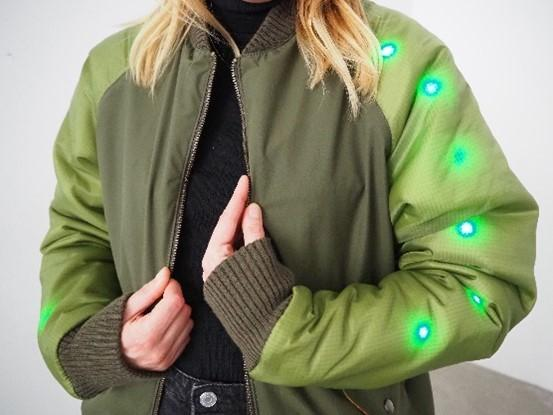
Another possibility is clothing with integrated LED elements. A person could customise the appearance of a jacket through a smartphone application, selecting different colours or patterns depending on their mood, outfit or social occasion.
The most interesting development, however, is the emergence of electronic textiles, often called e-textiles. Instead of attaching a rigid electronic screen to a garment, researchers are exploring ways to integrate electronic functionality directly into fibres and fabrics.
This could make technology feel like a natural part of clothing rather than an additional gadget.
Britain Is Already Exploring the Future of Smart Fabrics
The UK has a strong reason to take an interest in this emerging industry. British universities and research institutions are investigating how electronic components can be incorporated into familiar textile materials.
One particularly interesting example comes from Nottingham Trent University, where researchers have been developing smart textiles designed to improve healthcare, safety and communication.
Their research includes garments with temperature sensors, electronic textile gloves that communicate information through vibrations, and textile-based systems that could help people with hearing or visual impairments.
These projects demonstrate that interactive clothing is not simply about creating fashionable jackets with colourful lights. It could also provide practical solutions to everyday problems.
The University of Southampton is another important contributor to the UK’s electronic textile research. Its researchers are involved in a major collaborative project focused on developing wearable electronics that are wireless, comfortable and capable of surviving ordinary wear and washing.
These developments are particularly relevant to British consumers because they address some of the biggest obstacles facing smart clothing: comfort, durability and convenience.
The challenge is no longer just making fabric respond to electronic signals. It is making that technology suitable for something people might genuinely want to wear every day.
Could Your Clothes Become Another Smartphone?
One of the most exciting possibilities is turning clothing into an alternative interface for digital devices.
At present, most people interact with technology through touchscreens, keyboards and voice assistants. Even smartwatches require users to look at a display or operate small controls.
Interactive garments could introduce a different approach.
Imagine travelling on a crowded London Underground train. Instead of taking out a phone, you could tap a designated area on your sleeve to pause music or receive a notification through a small vibration.
A runner exploring a park in Manchester might use gestures recognised by a smart sports jacket to control a music playlist. Meanwhile, a cyclist could receive directional information through subtle vibrations built into their clothing.
These functions could make everyday technology more convenient, especially when people are carrying shopping bags, exercising or travelling.
Some researchers are also exploring textile displays that can show images and respond to touch. Such innovations suggest that future garments might eventually perform some of the functions currently associated with portable electronic devices.
Nevertheless, clothing will not necessarily replace smartphones. A more realistic possibility is that interactive garments will work alongside existing devices, offering an additional way to access information without constantly looking at a screen.
Fashion Could Become More Personal Than Ever
For the British fashion industry, interactive clothing offers an opportunity to rethink personal style.
Traditional garments generally have a fixed appearance. A black jacket remains black, a patterned dress keeps the same design, and changing an outfit usually means changing clothes.
Smart materials could make this process much more flexible.
A jacket with colour-changing elements might display a subtle design during the working day and a completely different pattern in the evening. A festival outfit could respond to music by producing coordinated lighting effects. Even accessories such as scarves, bags and trainers could incorporate interactive features.
This could be particularly appealing in the UK, where fashion culture ranges from traditional tailoring and streetwear to experimental designs at London Fashion Week.
Independent designers could potentially use electronic fabrics to create garments that change their appearance without requiring multiple layers or complicated accessories.
There is also an opportunity for consumers to customise clothing through applications. Instead of purchasing several versions of the same item in different colours, shoppers might eventually be able to adjust the appearance of a single garment digitally.
However, this idea raises an important question: will people actually want their clothes to change constantly?
For some consumers, personal style is closely connected to simplicity and timeless design. Interactive fashion will therefore need to offer meaningful creative possibilities rather than adding technology simply because it is available.
The Role of Sensors, Wireless Technology and Batteries
Behind every interactive garment is a combination of electronic components working together.
Depending on its intended function, a smart jacket or dress might contain temperature sensors, motion detectors, flexible circuits, wireless communication modules and small lighting elements.
These components need electrical power, which creates an important design challenge.
Unlike conventional gadgets, clothing must remain lightweight, flexible and comfortable while people walk, sit, bend and move throughout the day. Bulky electronic components could make garments uncomfortable and reduce their appeal.
This is why designers and engineers are exploring smaller power systems, flexible connections and improved energy management.
The development of suitable consumer electronics battery technology will be particularly important. A garment that displays patterns or responds to touch needs a dependable source of power without becoming heavy or restrictive.
For everyday consumers, battery performance could determine whether interactive clothing becomes a practical purchase or simply an interesting demonstration.
A smart coat designed for outdoor activities, for example, might need to operate for several hours without frequent charging. Meanwhile, a lightweight interactive T-shirt could prioritise compact electronics and minimal power consumption.
Future designs may also explore removable power modules, allowing users to detach electronic components before washing their clothes.
This would make maintenance easier and could help extend the useful life of both the garment and its electronic systems.
Could Interactive Clothing Transform Sports and Outdoor Activities?
Sport is another area where interactive fashion could attract considerable interest in Britain.
Running, cycling, football and hiking are popular activities across the country, and many people already use wearable devices to track performance.
Smart clothing could take this experience further by placing sensors directly into garments.
For example, a smart running top might monitor movement patterns, helping athletes understand their posture and running technique. Sportswear could also detect changes in body temperature and provide feedback when conditions become uncomfortable.
For cyclists travelling through busy British cities, illuminated jackets could potentially improve visibility after dark. Interactive lighting could respond to braking movements or changes in surrounding conditions.
Outdoor enthusiasts might also benefit from jackets that adjust their insulation according to temperature changes. Although such technology is still developing, it could make clothing more responsive to unpredictable British weather.
The advantage is that these features could be incorporated into items people already need, rather than requiring them to purchase several separate devices.
Of course, sportswear must remain breathable and comfortable. A technically impressive garment will struggle to attract customers if it restricts movement or feels unpleasant during exercise.
Interactive Clothing Could Make Everyday Life More Accessible
Perhaps the most meaningful applications of smart clothing are not related to fashion at all.
Electronic textiles could help people who face difficulties using conventional technology.
For example, gloves containing small vibration components could translate certain digital notifications into tactile signals. This could provide another way for people with hearing or visual impairments to receive information.
Similarly, a smart pillow cover might vibrate when a fire alarm or another important household alert is activated. A person who cannot rely on audible warnings could receive an alternative signal through touch.
Temperature-monitoring garments could also help identify potentially dangerous changes in body temperature, particularly among vulnerable older people.
These applications show why interactive clothing deserves attention beyond the fashion industry. It could become a useful form of assistive technology, allowing people to access information in ways that are more comfortable and natural for them.
In the UK, where accessibility and inclusive design are increasingly important considerations, this could become a particularly valuable area of innovation.
What Is Stopping Smart Clothing From Becoming Mainstream?
Despite its potential, interactive clothing still faces several obstacles.
The first is price. Integrating sensors, electronic fibres and wireless technology into garments can be more expensive than producing conventional clothing. If a simple smart jacket costs several times more than an ordinary alternative, many shoppers may hesitate.
The second challenge is washing. Clothing needs regular cleaning, but electronic components are not always designed to withstand water, detergent and repeated mechanical movement.
Researchers are working on washable electronic textiles, but commercial products must demonstrate reliable performance over extended periods.
The third issue is battery life. Consumers generally expect clothing to be ready whenever they want to wear it. Having to charge a jacket every evening could quickly become irritating.
A suitable consumer electronics battery therefore needs to balance capacity, size, weight and safety. Designers will also need to consider whether batteries can be removed easily and replaced when their performance declines.
Privacy is another concern. If garments collect information about body temperature, movement, location or other personal data, users will want to understand exactly how that information is stored and shared.
Finally, there is the question of fashion itself. Technology companies may be excited about adding displays and sensors to clothing, but consumers still want garments that look attractive and suit their personal style.
The most successful products will probably be those in which the technology is almost invisible until it is needed.
Will British Consumers Embrace Clothing That Thinks?
The future of interactive fashion will depend on whether manufacturers can combine technological innovation with genuine consumer benefits.
Younger shoppers who enjoy gaming, music festivals and experimental fashion may be interested in garments that change colours or react to their surroundings. Fitness enthusiasts might prefer clothing that provides useful performance information. Meanwhile, people looking for accessible technology could value garments that communicate through touch or monitor important health indicators.
Different consumers will have different expectations, meaning that the market is unlikely to be dominated by one type of smart garment.
Fashion brands may also need to work more closely with electronics manufacturers. Designers understand materials, appearance and fit, while technology companies bring expertise in sensors, wireless communication and power management.
This collaboration could produce products that feel less like experimental gadgets and more like ordinary clothing with useful additional capabilities.
Another important consideration is sustainability. British shoppers are increasingly interested in clothing that lasts, and electronic fashion should not become another source of short-lived technology waste.
Modular components, replaceable electronics and recyclable materials could help address this concern. If a battery or sensor can be replaced without discarding an entire jacket, the garment may offer better long-term value.
The Future of Fashion May Be Woven With Technology
Interactive clothing still has a long way to go before it becomes a normal feature of British high streets. However, research into electronic textiles, wearable sensors and responsive materials suggests that the relationship between fashion and technology is changing.
The next major fashion innovation may not be a new fabric colour, a different silhouette or another seasonal trend. It could be a garment that responds to the person wearing it.
Imagine walking through London in a jacket that adjusts its appearance, using a sleeve to control music on a journey through Birmingham, or wearing sportswear that quietly provides useful feedback during a weekend run.
Such experiences may sound futuristic today, but the research behind them is already taking place.
As technology becomes smaller and fabrics become more sophisticated, the distinction between clothing and electronic devices could gradually become less obvious.
The development of reliable consumer electronics battery solutions, washable electronic materials and comfortable wearable components will help determine how quickly this transformation happens.
Ultimately, the future of British fashion may not involve choosing between looking stylish and using advanced technology. It could allow people to enjoy both, with their clothes becoming more expressive, useful and interactive than ever before.