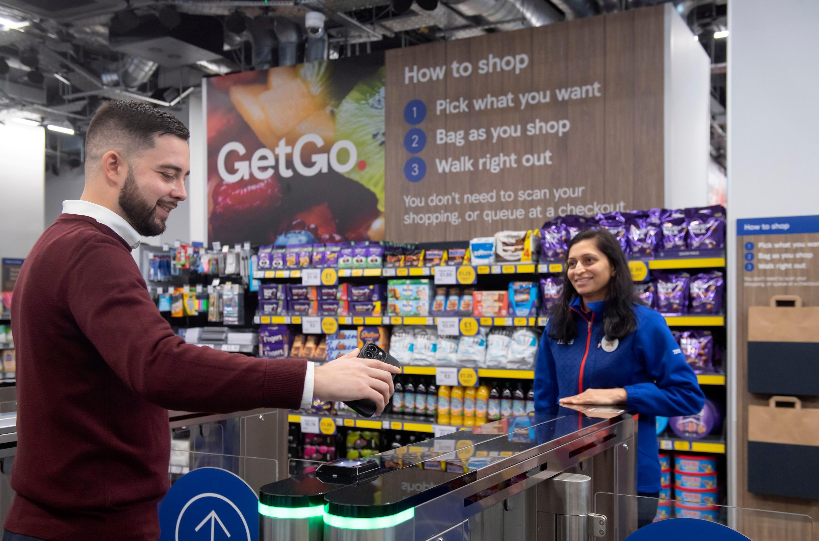
Imagine Shopping Without a Checkout Queue
Imagine walking into a British supermarket, picking up a basket of groceries, choosing your favourite snacks, adding milk and bread, and heading towards the exit without scanning a single barcode. No long queue, no frustrating self-checkout machine, and no awkward moment when the machine announces that an unexpected item is in the bagging area.
It sounds like something from a science-fiction film, but this shopping experience is becoming increasingly realistic. Artificial intelligence, smart shopping trolleys, computer vision and automated payment systems are changing the way supermarkets operate.
For British shoppers, who are familiar with busy Saturday supermarket queues and the familiar beeping of barcode scanners, the possibility of shopping without traditional scanning could represent a major change.
However, there is an important distinction between leaving without scanning every individual product and leaving without using a checkout at all. Several British retailers are experimenting with different approaches, and the results suggest that the future of grocery shopping might be more complicated, and more interesting, than simply removing every till.
Morrisons Is Bringing AI Shopping Trolleys to British Shoppers
One of the most interesting developments in British supermarket technology is happening in Lancashire.
In July 2026, Morrisons began trialling AI-powered Caper smart shopping trolleys at its Ashton-on-Ribble store in Preston. The technology, developed by Instacart, can recognise products placed inside the trolley, calculate the running total and display purchases on an integrated screen.
Instead of scanning every item individually at a traditional checkout, customers can place products directly into the trolley and allow its technology to identify them.
The screen can show the growing shopping bill, helping customers understand how much they are spending before reaching the end of their shopping trip. It can also recommend related products.
This development is particularly interesting because it changes the shopping experience rather than simply making the checkout faster.
For example, someone shopping with a £60 budget can see the total increasing as they move through the supermarket. If the trolley shows that the basket has already reached £55, the customer can reconsider whether another expensive item is really necessary.
There are also potential benefits for shoppers who find traditional supermarket environments difficult to navigate. Having a visible shopping list and running total may make the experience more manageable.
Nevertheless, smart trolleys are not completely automatic. Customers still need to complete the payment process, using the trolley’s screen rather than simply walking out of the supermarket.
Morrisons’ experiment could therefore offer an interesting middle ground between conventional shopping and fully checkout-free retail.
Why Britain’s Supermarket Checkout Experiments Have Not Always Worked
The idea of walking into a supermarket and leaving without visiting a checkout is not new in Britain.
Amazon introduced its Just Walk Out concept to UK shoppers through Amazon Fresh stores in 2021. The system used cameras, sensors and artificial intelligence to identify the products customers selected.
Shoppers entered the store, picked up their groceries and left. Their purchases were automatically recorded and charged to a linked payment method.
Aldi also experimented with its Shop & Go concept in Greenwich, London, while Sainsbury’s introduced SmartShop Pick & Go at its Holborn Circus location.
However, the technology did not develop into the nationwide shopping revolution that some industry observers originally expected.
Sainsbury’s removed Amazon’s Just Walk Out technology from its Holborn store in 2025, while Aldi ended its Greenwich Shop & Go experiment in March 2026.
These developments demonstrate that removing traditional checkouts is not necessarily the easiest way to improve supermarket shopping.
Technology installation can be expensive. Cameras, sensors, software, payment systems and maintenance all require investment. Supermarkets must also ensure that their systems accurately recognise different products and correctly calculate every customer’s bill.
A small mistake can create a frustrating experience. Imagine picking up two similar-looking packets of biscuits and discovering that the system has charged you for the more expensive one.
For retailers, customer confidence is just as important as technological innovation.
Can Artificial Intelligence Recognise Everything in Your Shopping Basket?
One of the biggest challenges facing checkout-free supermarkets is product recognition.
Traditional barcode scanners are relatively straightforward. A shopper scans a barcode, the checkout retrieves the product information and the price appears on the screen.
AI-powered shopping systems work differently.
They may combine cameras, image recognition, weight sensors and other technologies to identify what customers have selected. Some systems can recognise products based on their packaging, shape and position.
However, supermarkets are full of unusual shopping situations.
A customer might put a packet of crisps inside a reusable shopping bag, move several products around, or pick up an item and return it to a different shelf. Fresh fruit and vegetables can also be difficult to identify because individual pieces do not always have identical shapes or weights.
Promotional packaging creates another challenge. A supermarket might sell several versions of the same product with slightly different labels.
If a system makes a mistake, the customer needs a straightforward way to correct the shopping record.
This is why hybrid shopping technology could become more practical than completely automated stores. Smart trolleys can reduce repetitive scanning while still allowing customers to check their purchases before paying.
What Happens to Payment Terminals When Supermarkets Become Smarter?
Although AI cameras and smart trolleys attract most of the attention, payment infrastructure remains an essential part of the supermarket experience.
Even if customers no longer need to scan individual products, retailers still need reliable ways to collect payments, confirm transactions and issue receipts.
Traditional point-of-sale terminals are particularly important in stores that offer multiple payment options. Customers may want to use contactless bank cards, chip-and-PIN payments or mobile wallets.
Some smart shopping systems may process payments through an app or directly through an integrated trolley screen. Other stores may retain conventional payment terminals as an alternative.
This creates new requirements for the hardware supporting supermarket transactions.
A portable payment device, for example, needs dependable power throughout a busy trading day. Staff may use handheld terminals for customer assistance, payment verification or other tasks around the store.
The POS terminal battery therefore remains a relevant component of modern retail infrastructure. Reliable power helps payment equipment remain available when customers need to complete a transaction.
As supermarkets introduce more connected devices, retailers will have to consider not only the software but also the practical maintenance of the hardware behind it.
Will British Shoppers Trust Supermarkets That Watch Their Every Move?
There is another question that supermarkets cannot ignore: privacy.
A checkout-free shopping experience sounds convenient, but some customers may feel uncomfortable knowing that cameras and intelligent systems are monitoring activity throughout the store.
In a conventional supermarket, shoppers are already familiar with security cameras. However, systems designed to recognise products and associate them with individual shopping accounts introduce a different level of data processing.
Customers may reasonably want to know what information is collected, how long it is stored and whether it is shared with other companies.
The concern is not necessarily that shoppers have something to hide. It is about having control over personal information.
For example, should a supermarket be able to build detailed profiles based on everything a customer purchases? Could shopping information be used to personalise advertising? What happens if an account is accessed by someone who is not authorised to use it?
These questions become particularly important when retailers combine loyalty programmes, payment information, shopping applications and AI-powered product recognition.
British consumers are increasingly familiar with digital services, but convenience does not automatically mean that everyone is comfortable with additional data collection.
Supermarkets will need transparent privacy policies and clear explanations if they want customers to embrace these new shopping methods.
Could Smart Trolleys Make Grocery Shopping More Affordable?
Another interesting possibility is the relationship between smart shopping technology and household budgets.
Food prices and everyday living expenses remain important concerns for many British households. Customers are often looking for ways to manage weekly grocery spending without sacrificing everything they enjoy.
A smart trolley could help by showing the total cost of a shopping trip in real time.
Traditional shopping can make it surprisingly easy to spend more than expected. A few extra snacks, an additional household product and an unexpected promotional offer can quickly increase the final bill.
With an integrated screen, customers can see the financial impact of their choices immediately.
The technology could also make supermarket promotions more interactive. A trolley might identify that a customer has selected pasta and suggest a related sauce or offer information about a multi-buy promotion.
However, there is a potential downside.
If recommendations become too aggressive, smart shopping technology could encourage people to purchase more rather than spend less.
The important question is whether these systems genuinely help customers make informed decisions or simply create another opportunity for supermarkets to influence purchasing habits.
For British families managing tight budgets, transparency will be essential.
Will Older Shoppers and Cash Users Be Left Behind?
Not every supermarket customer wants to use an app or interact with a touchscreen.
Some shoppers prefer speaking to a cashier, while others are more comfortable paying with cash. Older customers, people with disabilities and individuals who do not regularly use smartphones may also find certain digital systems difficult.
This is why supermarkets should avoid assuming that every customer wants the fastest possible shopping experience.
A traditional checkout can provide something that automated technology sometimes struggles to reproduce: human assistance.
A customer might need help finding a product, understanding a promotion or resolving a payment problem. A friendly employee can often deal with these situations more naturally than a machine.
There is also a practical question about what happens when a customer’s smartphone runs out of power or an application stops working.
Retailers should provide alternative payment methods and accessible shopping options rather than making digital participation compulsory.
A successful smart supermarket should make shopping easier for more people, not create additional barriers for those who prefer familiar methods.
The Technology Behind the Scenes Will Matter More Than Ever
A modern supermarket is increasingly becoming a connected digital environment.
Smart trolleys, electronic shelf labels, inventory sensors, self-service machines and payment terminals all need to communicate reliably.
If one part of the system stops working, the effects can spread throughout the store.
For example, a network problem could prevent a trolley from updating its shopping total. A payment terminal might lose connectivity just as a customer is ready to pay. A hardware fault could force employees to switch customers back to a traditional checkout.
This is why retailers must invest in dependable equipment, regular maintenance and backup arrangements.
Power management is another important consideration.
Mobile scanners, handheld payment devices and portable retail equipment depend on rechargeable power sources. Their performance can influence how smoothly employees serve customers during busy periods.
The POS terminal battery is one example of a relatively small hardware component that can have a significant impact on everyday retail operations.
A supermarket might spend considerable money installing advanced AI systems, but customers will still expect the payment process to work when they reach the final stage of their shopping trip.
The POS terminal battery is therefore part of a much wider conversation about reliability in increasingly automated retail environments.
Will the Traditional Supermarket Checkout Disappear?
It is tempting to imagine a future in which every British supermarket operates like a giant vending machine.
Customers enter, collect their groceries and leave, with artificial intelligence handling everything automatically.
But the recent experience of UK retailers suggests that the future is unlikely to be quite so simple.
Amazon’s checkout-free experiments, Aldi’s Shop & Go concept and Sainsbury’s Pick & Go technology have shown that removing traditional checkouts can be technically impressive without necessarily becoming the preferred shopping method for everyone.
Morrisons’ AI-powered shopping trolley trial offers a different direction. Instead of eliminating the checkout experience entirely, it reduces the need to scan products individually while keeping a payment step.
This approach may be more practical because it combines convenience with customer control.
Supermarkets could eventually offer several shopping options under one roof: traditional staffed checkouts, self-service machines, handheld scanners, smart trolleys and more automated payment systems.
Customers would then be able to choose the experience that suits them.
A New Shopping Experience Is Coming, But Customers Will Decide Its Future
The British supermarket is changing, and artificial intelligence is beginning to influence even the most ordinary activities, from choosing groceries to paying for a weekly shop.
The arrival of smart shopping trolleys in Lancashire demonstrates that scan-free shopping is no longer just an idea for futuristic retail demonstrations. It is becoming something that ordinary shoppers can experience.
However, the success of these technologies will depend on more than clever cameras and impressive software.
They must work accurately, protect personal information, support different payment preferences and offer genuine value to customers.
Retailers will also need dependable payment equipment, including suitable POS terminal battery solutions for the devices that keep everyday transactions running.
Perhaps the future of British supermarket shopping will not involve completely abandoning checkouts. Instead, it may be about giving customers more freedom to decide how they shop.
After all, most people do not necessarily dream of interacting with more technology when buying bread, milk and eggs. They simply want to get what they need, pay the correct amount and get home without spending half an hour waiting in a queue.
If smart trolleys and automated retail systems can deliver that experience reliably, British shoppers may eventually find that scanning every item is something they no longer need to do.