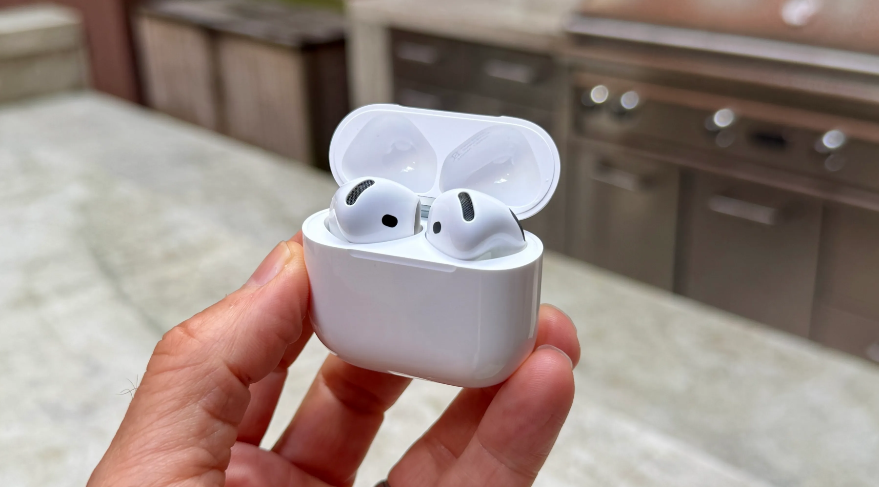
A New Chapter for Apple’s Everyday Earbuds
Apple’s latest AirPods launch has attracted considerable attention in the UK, but the biggest story is not simply that the company has made another pair of wireless earbuds. The AirPods 5 represent a broader shift in what consumers expect from everyday audio devices.
Announced in September 2026 alongside Apple’s latest iPhone and Apple Watch products, AirPods 5 bring Active Noise Cancellation to Apple’s open-ear design while also introducing a redesigned acoustic architecture, Adaptive EQ and several intelligent audio features. Apple says the new model can provide up to 1.5 times more noise cancellation than the previous AirPods 4 with Active Noise Cancellation.
For British consumers, this arrives at an interesting time. Wireless earbuds are no longer used only for listening to music. They have become part of the daily routine for commuters, remote workers, students, gym users and people who spend hours moving between home, public transport and busy city streets.
That makes the AirPods 5 story much bigger than a simple specification upgrade.
Why Noise Cancellation Matters in Britain
The UK provides a particularly interesting environment for noise-cancelling earbuds. Daily journeys can involve trains, Underground services, buses, airports and busy high streets. London commuters, for example, can experience a rapid change from a quiet home environment to a crowded station and then a noisy train carriage.
Traditional in-ear earbuds can reduce external sound partly because their ear tips physically seal the ear canal. AirPods 5 take a different approach by maintaining an open-ear style while using computational audio and a redesigned acoustic system to improve noise cancellation.
Apple says its new system removes up to 50 percent more external noise than AirPods 4 with Active Noise Cancellation.
This distinction matters because comfort remains an important part of the wireless-earbud experience. Some people prefer earbuds without silicone tips because they feel less intrusive during long listening sessions.
For someone spending an hour commuting into central London, the appeal is obvious. The earbuds can provide a quieter listening environment without completely changing the physical sensation of wearing headphones.
The Real Upgrade Is More Than ANC
It would be easy to describe AirPods 5 as an ANC upgrade, but that would overlook several other changes.
Apple has introduced a new multiport acoustic architecture and next-generation Adaptive EQ. These technologies are designed to produce a richer and more immersive listening experience while automatically adjusting the sound according to the listening environment.
The improved Transparency mode is also significant. Instead of simply switching between blocking outside noise and allowing it through, the system is designed to provide a more natural representation of voices and nearby sounds.
That could be particularly useful in Britain, where people often move between different environments throughout the day.
Imagine listening to a podcast on a train and then arriving at a coffee shop. Rather than taking the earbuds out whenever someone speaks to you, Transparency mode can make it easier to remain aware of what is happening around you.
This is where modern earbuds are becoming less like traditional headphones and more like personal audio assistants.
Battery Life Still Shapes the Everyday Experience
For wireless earbuds, advanced features mean little if users constantly have to think about charging. As ANC becomes more sophisticated and earbuds take on additional roles, battery efficiency remains an important part of the overall experience.
The standard AirPods 5 can provide up to four hours of listening time with Active Noise Cancellation on a single charge. The AirPods 5 with Wireless Charging Case increase this to up to five hours, while the wireless charging case can provide up to 22 hours of total battery life with ANC.
For many users, the charging case is therefore just as important as the earbuds themselves.
Someone travelling from Manchester to London, for example, may not think about the individual charging cycles until the earbuds are used repeatedly throughout the day. When wireless audio becomes part of commuting, calls, music and navigation, battery performance becomes a practical consideration rather than a technical specification.
This is why discussions around AirPods battery performance are likely to remain relevant as the new generation becomes more widely used.
The case also supports USB-C charging, while the wireless charging version can be charged using an Apple Watch charger or a Qi-compatible charger.
A More Intelligent Pair of Earbuds
Another reason AirPods 5 are attracting attention is the growing connection between wireless audio and intelligent software.
The new earbuds support features including Live Translation and Siri AI when used with compatible Apple devices.
This points toward a broader change in consumer electronics.
For years, earbuds were essentially miniature speakers and microphones. Now they can become an interface between users and the software running on their phones.
A British traveller could potentially use compatible translation features while communicating in another language. A commuter could interact with Siri without reaching into a pocket. Someone listening to content could move between different audio modes depending on the environment.
These functions make the earbuds more useful even when no music is playing.
The important point is that Apple is not treating the AirPods purely as an audio accessory. They are increasingly becoming part of the company’s wider ecosystem of personal devices.
The Wireless Charging Version Adds More Convenience
Apple is also offering a higher-end AirPods 5 configuration with a Wireless Charging Case.
This version provides longer single-charge battery life and adds volume control through a force sensor and swipe interaction on the stem. It can also be charged through compatible wireless charging systems.
For people who already use several Apple devices, this can simplify the charging routine.
Instead of having separate charging accessories scattered around a home or office, compatible wireless charging solutions can create a more unified setup. This may sound like a small improvement, but convenience is often what determines whether consumers continue using a device every day.
The wireless charging model also highlights an important trend in premium consumer electronics: people increasingly expect accessories to work together rather than operate as isolated products.
Better Durability for Everyday British Weather
Another practical change is the IP57 rating on AirPods 5, which provides improved resistance to dust, sweat and water.
That is useful in everyday situations rather than just extreme conditions.
The UK’s unpredictable weather can mean leaving home under clear skies and returning in light rain. Add commuting, walking, cycling and exercise to the equation, and durability becomes more important for a device that people carry every day.
AirPods are still small electronic devices and should not be treated as waterproof equipment. However, improved resistance can give users greater confidence during normal activities.
It also reflects a wider direction in consumer electronics. Smartphones, watches and earbuds are increasingly designed to survive the realities of everyday life rather than being used only in controlled indoor environments.
AirPods Are Becoming More Than Music Devices
Perhaps the most interesting development is the changing definition of what wireless earbuds are for.
Music remains central, but modern earbuds can also handle calls, podcasts, navigation, translation, voice assistants, spatial audio and environmental awareness.
That means battery performance becomes connected to almost every part of the user experience.
When an earbud is used for three minutes to take a call, twenty minutes to listen to a podcast and another hour for music, the battery is supporting several different functions throughout the day.
For heavy users, monitoring AirPods battery health can therefore become part of normal device management, just as people monitor their smartphone battery.
This is especially relevant as manufacturers continue adding sensors, processors and intelligent features to small wearable devices.
The more functions an earbud performs, the more important efficient power management becomes.
What British Consumers Will Be Watching
The AirPods 5 launch comes during a busy period for Apple in the UK. The company has also introduced new iPhone and Apple Watch products, creating a wider ecosystem story around its latest hardware. UK operators including EE and O2 have announced plans to offer the new Apple products, including AirPods 5.
That ecosystem connection could be important for existing iPhone users.
Consumers may not purchase AirPods because of one individual specification. Instead, they may value the way the earbuds work with their phone, watch and other Apple services.
This approach is becoming increasingly common across consumer electronics. Hardware is no longer just about physical components. Software integration, cloud services and device compatibility can have an equally important influence on the everyday experience.
Is the AirPods 5 Launch Really About Sound?
In many ways, the answer is no.
The biggest change is not simply louder music or stronger noise cancellation. It is the transformation of the humble wireless earbud into a more versatile personal device.
AirPods 5 combine open-ear comfort, Active Noise Cancellation, adaptive audio, spatial audio, voice interaction and translation features in a compact product. Apple has also improved durability and charging options while keeping the basic AirPods concept familiar.
For British users, the practical benefits can be easy to imagine: quieter commuting, clearer conversations, hands-free interaction and a more flexible listening experience throughout the day.
At the same time, consumers will still need to consider their own usage patterns. People who prioritise maximum isolation may prefer sealed in-ear designs, while those who value an open-ear feel may appreciate Apple’s approach.
The Next Stage of Everyday Audio
The AirPods 5 launch shows how quickly wireless earbuds are evolving.
What began as a convenient replacement for wired earphones has become an important category within consumer electronics. The latest generation is expected to play a role in music, communication, travel, translation and interaction with intelligent software.
As these functions expand, power management will become increasingly important. The smaller the device becomes while the number of functions increases, the more carefully manufacturers need to balance performance, battery capacity and efficiency.
For consumers, this means that discussions about AirPods battery life are no longer just about how many hours of music can be played. They are about how reliably a tiny personal computer can support a full day of modern communication and entertainment.
AirPods 5 therefore arrive at an interesting moment. Their story is not simply about better noise cancellation. It is about how a familiar everyday accessory is gradually becoming a smarter, more capable and more deeply integrated part of personal technology.