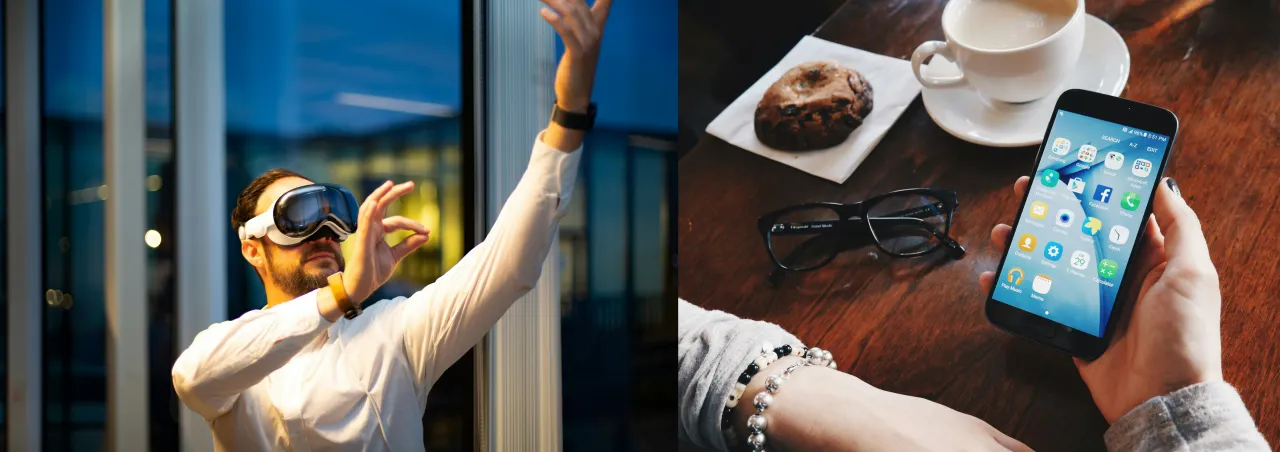
For more than a decade, the smartphone has been the centre of everyday digital life in Britain. It is the device people reach for when they wake up, check the weather on the train, navigate unfamiliar streets, pay for lunch, take photographs and send messages. Even when other gadgets become fashionable, the smartphone usually remains the one device people cannot leave at home.
But that comfortable position is beginning to look less secure.
Smart glasses are moving from science-fiction territory into real consumer technology. In 2026, glasses can already take photographs, play music, answer questions, provide directions and interact with artificial intelligence without requiring users to pull a phone from their pocket. Google has announced intelligent eyewear powered by Gemini, with features designed to let users get directions, send messages and take photos without taking out a smartphone.
At the same time, companies including Meta, Samsung and Google are competing to define what the next generation of wearable technology should look like.
So, as smart glasses become more capable, one fascinating question is emerging across the UK: could smart glasses eventually become more important than smartphones?
The Smartphone Still Rules British Daily Life
It would be easy to underestimate how difficult it will be for smart glasses to replace smartphones.
The smartphone is not simply a communication device. It is a camera, banking terminal, entertainment system, navigation tool, work computer, shopping platform and personal organiser all in one. Millions of British consumers have spent years building their digital lives around a handset.
That creates a powerful habit.
When someone receives a message, they instinctively reach into a pocket. When they want to photograph a beautiful sunset over the Lake District, they take out their phone. When they need to compare train times, check a restaurant or make an online payment, the smartphone is already there.
There is also the issue of screen size. Even the most advanced smart glasses cannot necessarily provide the same comfortable experience as a large smartphone display. Reading a long email, editing a document, browsing an online shop or watching a full-length film can still be much easier on a conventional screen.
Battery life is another practical consideration. A modern smartphone has to power a bright display, powerful processors, cameras, wireless connections and increasingly sophisticated AI features. As consumers demand more from their handsets, the importance of a reliable smartphone battery is unlikely to disappear.
In other words, smart glasses may challenge the smartphone without immediately replacing it.
Smart Glasses Are Winning Because They Feel More Natural
The biggest advantage of smart glasses is not necessarily their specifications. It is the fact that they can make technology feel less visible.
A smartphone demands attention. You look down at it. You hold it. You interact with a screen.
Smart glasses can work differently.
Imagine walking through central London while visiting for the weekend. Instead of repeatedly checking your phone for directions, you could ask your glasses where to go. Instead of stopping to photograph an interesting building, you could simply use a voice command. If you are carrying shopping bags, travelling with luggage or cycling through the city, hands-free technology suddenly becomes much more attractive.
This is where artificial intelligence could make smart glasses particularly powerful.
Google has already demonstrated an Android XR direction in which intelligent eyewear can provide directions, send texts and capture photographs through natural interaction.
The idea is simple: technology should respond to the user rather than forcing the user to constantly respond to technology.
That could be a surprisingly important change.
Britain Is Becoming a Test Market for AI Eyewear
The UK is an interesting market for smart glasses because British consumers are already familiar with wearable technology.
Smartwatches have become normal. Wireless earbuds are everywhere. Contactless payments are part of everyday life. People are increasingly comfortable carrying small connected devices that communicate with their phones.
Smart glasses therefore do not have to introduce the idea of wearable technology from scratch.
However, Britain is also proving that consumers have questions about how these devices should be used.
Meta’s smart glasses have recently faced restrictions in a number of UK cinemas because of concerns about privacy and piracy. Courts in England and Wales have also introduced restrictions concerning the use of Meta’s AI-powered glasses.
These developments highlight an important difference between smart glasses and smartphones.
A smartphone is usually obvious when someone is using it to record. A person raises the phone, points it at a subject and looks at the screen.
Smart glasses can be much more discreet.
That creates a new social problem: how does someone know when another person is recording them?
The Privacy Question Could Decide the Winner
Technology enthusiasts often focus on cameras, processors and AI features when discussing the future of smart glasses.
British consumers may care about something else: trust.
Imagine sitting in a café and noticing that the person at the next table is wearing AI glasses. Are they listening to music? Asking an AI assistant a question? Taking a photograph? Recording the conversation?
You might not know.
This uncertainty could become one of the biggest obstacles facing smart glasses.
The technology may be impressive, but consumers will need confidence that public spaces will not become places where everyone can potentially record everyone else.
That is why recent restrictions in British cinemas and legal settings are so significant. They demonstrate that the debate is no longer theoretical. Smart glasses are becoming real enough to require real-world rules.
The companies that solve this trust problem may have an enormous advantage.
AI Could Turn Glasses Into a Personal Assistant
The most exciting possibility is that smart glasses will not simply become another screen.
Instead, they could become an interface for artificial intelligence.
Consider a typical morning.
You leave your home in Manchester and ask your glasses about the weather. They tell you rain is expected later. While walking to the station, you ask for the fastest route. At work, you receive a message and respond by voice. During lunch, you see a menu in another language and ask your glasses to explain it.
Later, you are shopping and see a product you do not recognise. You ask the glasses what it is and whether there are cheaper alternatives.
None of these tasks necessarily requires a traditional smartphone interaction.
This is the real threat to the smartphone: not that smart glasses will copy everything a phone can do, but that they may remove the need to perform many small tasks on a screen.
The phone could gradually become the powerful computer that stays in your pocket while the glasses become the device through which you interact with it.
The Smartphone May Not Disappear at All
Despite all the excitement, predicting the death of the smartphone would be premature.
A more realistic future may involve the two devices working together.
The smartphone could remain responsible for heavy computing, large-screen activities, storage and complex applications. Smart glasses could handle quick interactions, notifications, navigation, photography and AI assistance.
This would resemble the relationship between smartphones and smartwatches.
A smartwatch did not destroy the smartphone. Instead, it made certain smartphone tasks faster and more convenient.
Smart glasses could follow the same path.
For example, someone might receive a notification through their glasses, reply using voice and continue walking without touching their phone. When they arrive home, they could pick up their smartphone for a longer conversation or more detailed task.
In this scenario, the smartphone remains essential but becomes less visible.
Battery Technology Will Matter More Than People Think
There is another issue that could determine whether smart glasses become genuinely mainstream: power.
A pair of glasses has very limited space for batteries. Consumers expect them to remain light, comfortable and stylish, which means manufacturers cannot simply add a huge battery whenever they want longer operating times.
Yet cameras, microphones, wireless connectivity, speakers and AI processing all consume energy.
This creates a difficult engineering challenge.
Users may accept charging a smartphone once a day, but they may become frustrated if their glasses need frequent charging. If the glasses stop working halfway through a journey, their most useful features disappear at exactly the wrong moment.
That means improvements in energy efficiency could become just as important as improvements in AI.
The same principle applies to smartphones. As AI features become more demanding, manufacturers need better energy management and more efficient components. A high-quality smartphone battery can therefore remain an important part of the wider connected-device ecosystem, even in a future where glasses become the main interface.
The Battle Is Also About Fashion
Technology alone will not decide whether smart glasses become mainstream.
They have to look good.
This may sound superficial, but eyewear is different from most consumer electronics. People wear glasses on their faces for hours at a time. They are part of personal style and identity.
This is one reason partnerships between technology companies and established eyewear brands are so important.
Meta’s collaboration with Ray-Ban helped make connected glasses look much more like ordinary sunglasses. Other companies are also exploring fashion-focused partnerships as they try to make intelligent eyewear less obviously technological.
Google has announced frames from brands including Gentle Monster and Warby Parker as part of its Android XR strategy.
The lesson is clear: consumers may not want to look like they are wearing a computer.
They simply want to wear a good-looking pair of glasses that happens to be extremely useful.
Apple Could Make the Competition Even More Interesting
The smartphone-versus-glasses debate could become even more intense as Apple develops its own strategy around intelligent eyewear.
Apple’s next major iPhone launch is scheduled for 9 September 2026, and reports suggest the company is also exploring the future of foldable and AI-powered devices.
If Apple eventually enters the smart-glasses market with a product deeply integrated with the iPhone, it could accelerate adoption among existing Apple users.
That would create an interesting ecosystem battle.
Meta has the advantage of experience with consumer smart glasses. Google has Android and Gemini. Samsung is developing its own ecosystem and has already attracted attention around AI glasses. Apple has an enormous installed base of iPhone users.
The winner may not simply be the company with the best glasses.
It could be the company that creates the smoothest relationship between glasses, phone, AI and other connected devices.
What Will British Consumers Actually Buy?
For British consumers, the decision may ultimately come down to convenience.
Nobody buys a gadget simply because it is futuristic.
People buy products that solve problems.
If smart glasses make commuting easier, help tourists navigate cities, provide useful translations, capture hands-free photographs and deliver information without constant phone checking, they have a genuine reason to exist.
If they merely reproduce smartphone functions in an uncomfortable frame while requiring frequent charging, consumers may quickly lose interest.
This is why the next few years will be so important.
Smart glasses have moved beyond the experimental stage, but they have not yet become as ordinary as smartphones or wireless earbuds. The technology is improving rapidly, while questions around privacy, etiquette and regulation are developing at the same time.
So, Which Gadget Will Win Britain’s Attention?
The answer may not be “smartphones” or “smart glasses”.
It may be both.
The smartphone has spent more than a decade becoming the centre of digital life. It has enormous advantages in computing power, screen size, battery capacity and software.
Smart glasses, meanwhile, offer something the phone cannot easily provide: a more natural and hands-free way to interact with digital information.
That difference could be enough to create an entirely new category of everyday technology.
The most likely future is therefore not a dramatic moment when millions of Britons throw their phones away. Instead, the change could happen quietly. People may start using their phones less often because their glasses handle small tasks for them. The phone remains in the pocket, ready when needed, while the glasses take care of everything that does not require a large screen.
And that could be the biggest shift of all.
The next great personal technology may not be the device we stare at.
It may be the device we barely notice we are wearing.