A New Era of Wearable Technology Meets Britain’s Privacy Debate
Smart glasses are becoming one of the most intriguing developments in consumer technology. Combining familiar eyewear with cameras, microphones, speakers and artificial intelligence, these devices promise to make everyday digital interactions faster and more convenient. Users can capture photographs, answer calls, listen to music, receive directions and access digital assistants without constantly reaching for a smartphone.
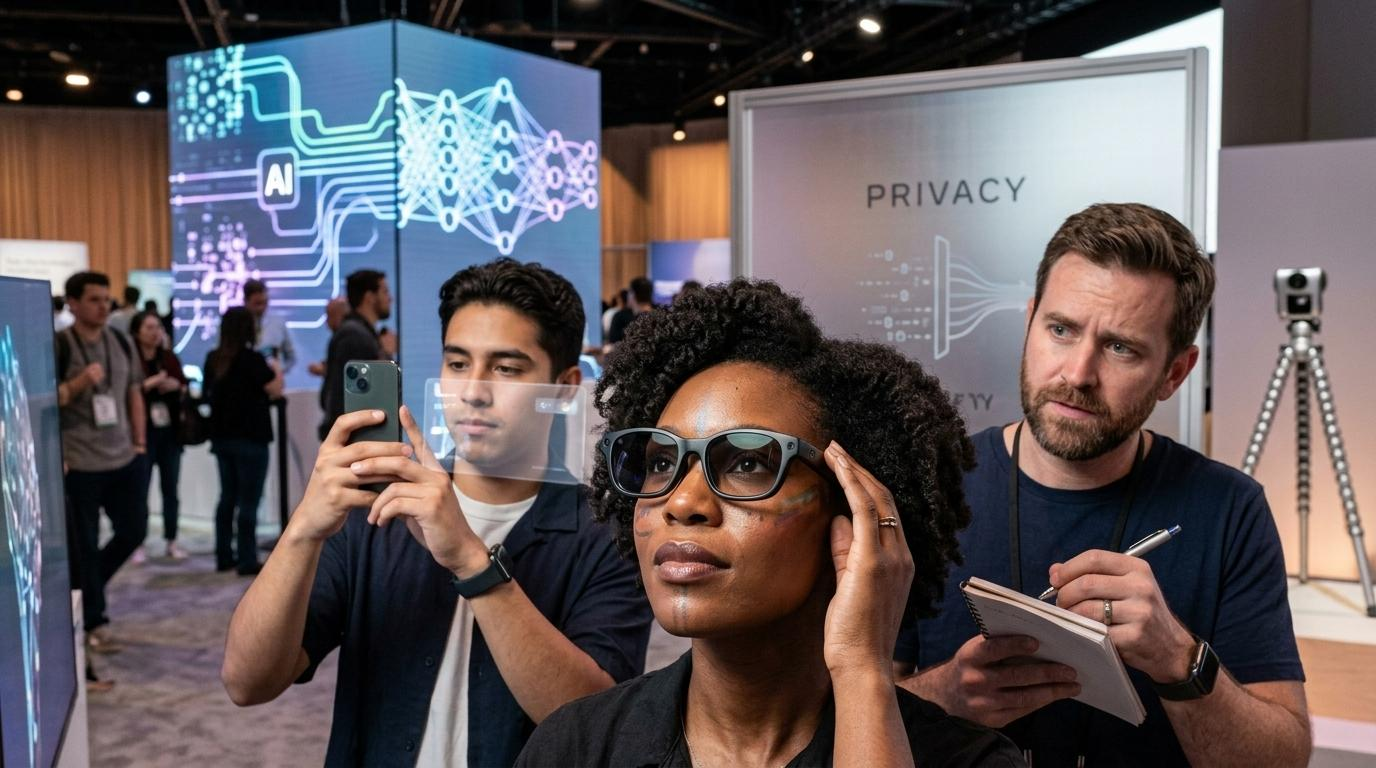
Yet as smart glasses become more sophisticated, they are also raising important questions about privacy, consent and responsible technology use across the United Kingdom. A device that looks like an ordinary pair of spectacles can potentially record people nearby, making it harder for members of the public to know when they are being filmed or recorded.
For British consumers, the debate extends beyond the novelty of wearable gadgets. It touches on expectations of privacy in pubs, shops, public transport, workplaces and other shared spaces. It also challenges technology manufacturers to demonstrate that innovation can coexist with clear boundaries and public trust.
Why Smart Glasses Are Attracting Attention
Traditional smart devices usually make their technological capabilities obvious. A smartphone camera is visible when someone raises a handset to take a photograph, while a conventional camcorder is difficult to mistake for anything else. Smart glasses are different because their cameras and microphones can be integrated into a compact frame.
That discreet design is part of their appeal. Someone walking through central London might use smart glasses to navigate unfamiliar streets, listen to messages or document a memorable moment without interrupting their journey. Cyclists and runners could benefit from hands-free information, while travellers might use translation features to understand conversations or signs.
Artificial intelligence is expanding these possibilities. Depending on the model and available software, smart glasses may help identify objects, answer questions about a scene, summarise information or provide spoken assistance. Instead of opening multiple applications, users can interact with technology more naturally.
However, convenience for the wearer can create uncertainty for everyone else. A person sitting opposite someone in a café might not know whether the glasses are simply being worn or actively recording. The central challenge is therefore not whether smart glasses are useful, but how their capabilities should be communicated and controlled in public.
The Privacy Problem Behind an Ordinary-Looking Frame
Privacy concerns arise when technology makes recording less noticeable. In the United Kingdom, people generally expect a degree of privacy even when they are outside their homes, although the precise legal protections depend on the circumstances.
Smart glasses complicate these expectations because recording can happen at eye level while the wearer continues an ordinary conversation. A small indicator light may signal that a camera is active, but its visibility, effectiveness and meaning can vary between products. People nearby may not recognise the indicator or understand what it means.
There is also a difference between taking a photograph and collecting information continuously. A short recording of a landmark is not the same as capturing conversations, faces and surrounding activity over an extended period. Once recorded, digital material may be stored, transferred, edited or shared, creating risks that continue long after the original encounter.
The concern becomes more serious when recordings involve children, vulnerable individuals or sensitive situations. Someone visiting a medical appointment, discussing a confidential matter or attending a private meeting may reasonably feel uncomfortable if they suspect they are being recorded without their knowledge.
Manufacturers cannot eliminate every risk through product design alone. Nevertheless, they can make recording indicators more noticeable, provide straightforward controls and explain clearly how data is processed. These measures would help users understand their responsibilities and give bystanders a better chance of recognising when their privacy might be affected.
What UK Data Protection Rules Mean for Smart Glasses
The UK’s data protection framework is relevant when smart glasses are used to collect and process identifiable information. The UK General Data Protection Regulation and the Data Protection Act 2018 establish important principles governing the handling of personal data.
Whether a particular recording falls within these rules depends on the circumstances, including the purpose of the recording, the identity of the person responsible and how the information is used. Personal or household activities may be treated differently from systematic recording for commercial purposes.
For businesses, the obligations can be more demanding. An organisation using wearable cameras to monitor employees, customers or visitors should consider whether the activity is necessary, proportionate and transparent. Depending on the circumstances, it may need a lawful basis for processing, appropriate privacy information and a data protection impact assessment.
Public spaces do not automatically remove all privacy considerations. Nor does the presence of a camera automatically make every recording unlawful. Context matters, and users should avoid assuming that a technically possible action is necessarily an appropriate one.
People who use smart glasses for work should pay particular attention to workplace policies, confidentiality requirements and restrictions on recording. A company may prohibit wearable cameras in particular areas even when using the device would otherwise appear convenient.
For consumers, the practical message is straightforward: understand the relevant rules, respect other people’s expectations and avoid recording sensitive interactions without a clear justification.
Can Better Product Design Rebuild Public Trust?
Technology companies have an opportunity to address privacy concerns before they become a barrier to adoption. Good design should make responsible behaviour easier rather than relying entirely on users to remember complicated rules.
A prominent recording indicator is one possible safeguard. Manufacturers could also provide physical camera covers, easily accessible recording controls and clear audible or visual notifications. Where technically feasible, devices could make it more difficult to record discreetly or continue recording accidentally.
Privacy settings should be understandable without requiring users to navigate lengthy technical menus. Buyers should be able to identify which features work locally on the device, which depend on cloud services and what information may be retained by the manufacturer.
Data minimisation is equally important. A device should not collect more information than is needed for its intended function. If a basic voice command can be processed without retaining a full conversation, manufacturers should explain whether that option is available.
Consumers should also examine how long recordings are stored, whether they can be deleted easily and whether third-party services receive the information. Clear answers can help distinguish genuinely privacy-conscious products from devices that simply advertise security as a selling point.
Ultimately, trust will depend on consistent behaviour. A small indicator light or a reassuring statement in a product advertisement cannot replace meaningful safeguards, transparent policies and effective enforcement.
Battery Life and the Practical Limits of Wearable Technology
Privacy is not the only issue shaping the future of smart glasses. These products must also balance performance, weight, comfort and battery life. Adding more powerful processors, cameras and AI features can increase energy consumption, while larger batteries may make frames heavier and less comfortable.
For consumers comparing devices, the quality of the consumer electronics battery can influence how useful the glasses are throughout a normal day. A model that performs well during a short demonstration may be less appealing if its charge runs down during commuting, travel or extended outdoor activities.
Manufacturers therefore face a difficult engineering challenge. They need to deliver enough energy for essential functions without making the frames bulky. Improvements in low-power processors, efficient wireless connections and software optimisation can help reduce demand.
Charging cases may offer a practical compromise, allowing users to replenish their glasses while travelling. However, buyers should examine the complete charging experience rather than relying on a headline battery-life figure. Recording duration, audio playback, AI processing and standby time can produce very different results.
The consumer electronics battery also has implications for long-term ownership. Rechargeable batteries gradually lose capacity through repeated use, and a wearable device may become less convenient if its endurance declines significantly. Buyers should investigate warranty coverage, battery service options and the availability of replacement components before making a purchase.
There is an environmental dimension, too. Products that are difficult to repair or contain batteries that cannot be serviced economically may be replaced sooner than necessary. Manufacturers that support repair, provide clear product information and design for durability could offer consumers a more sustainable alternative.
Smart Glasses in British Workplaces and Public Transport
The UK’s crowded public environments provide a useful test of whether wearable technology can earn widespread acceptance. On a busy train, a passenger may want to listen to directions or answer a call without disturbing others. Another passenger, however, may be concerned about being captured in a recording.
The same tension appears in offices, universities, gyms and hospitality venues. Smart glasses could help employees access instructions hands-free, assist people with certain accessibility needs or support maintenance work. Yet they may be inappropriate in confidential meetings, changing areas or locations where sensitive information is visible.
Clear policies can prevent confusion. Employers should explain where wearable cameras are permitted, when recording is allowed and how information must be handled. Public venues may also establish reasonable restrictions suited to their activities.
Users can reduce friction by adopting simple habits. They should tell people when recording is relevant, disable cameras when they are unnecessary and respect requests not to film. In private or sensitive environments, removing the glasses may be the most considerate choice.
These steps matter because public acceptance is not guaranteed by technical progress. A device may be innovative and legally available while still being unwelcome in particular social situations.
Accessibility Could Be One of the Strongest Arguments for Adoption
The privacy debate should not overshadow the potential benefits of smart glasses. For people with visual impairments or other accessibility needs, wearable technology could provide useful assistance without requiring constant interaction with a handheld screen.
Depending on the device, software and user requirements, spoken navigation, text reading, object descriptions and hands-free communication may support greater independence. Travellers could also benefit from translation tools, while workers may use wearable displays to consult instructions without interrupting practical tasks.
These applications require careful development. AI-generated descriptions can be inaccurate, and users should not rely on them uncritically in situations where mistakes could cause harm. Accessibility features should be tested with the communities they are intended to serve.
Privacy protections are particularly important in this context. People who rely on wearable assistance should not have to sacrifice unnecessary amounts of personal information to access useful functions. Manufacturers should aim to provide meaningful choices about data collection, storage and sharing.
A balanced approach recognises that the same device can create risks in one situation and deliver substantial benefits in another. Sensible policies should address actual behaviour and context rather than treating every use of smart glasses as inherently harmful.
What Buyers Should Check Before Choosing a Pair
British consumers considering smart glasses should evaluate more than appearance, brand reputation and advertised AI capabilities. The following factors can help establish whether a product is suitable for everyday use.
First, examine the recording controls. Check whether the camera is easy to disable, whether recording is clearly indicated and whether the device can accidentally capture material in the background.
Second, read the privacy policy. Understand which information is processed on the glasses, which features require cloud services and how recordings or voice interactions may be stored. Check whether deletion controls are straightforward.
Third, consider security. Look for information about software updates, account protection and the handling of data transmitted between the glasses, a smartphone and online services.
Fourth, evaluate comfort and endurance. The consumer electronics battery should support the activities that matter most to you, whether those involve navigation, music, calls or occasional photography. Compare realistic usage estimates and charging arrangements instead of relying exclusively on manufacturers’ best-case figures.
Finally, consider the social environment in which the glasses will be used. A product that works well for solo navigation or accessibility assistance may not be appropriate for every workplace, social gathering or private conversation.
Taking these factors into account can help buyers avoid expensive disappointment while encouraging manufacturers to compete on responsible design as well as technical features.
The Future Depends on More Than Artificial Intelligence
Smart glasses illustrate a wider challenge facing the consumer technology industry. Devices are becoming smaller, more connected and increasingly capable of interpreting the world around their users. That creates exciting opportunities, but it also makes the boundaries between personal convenience and other people’s privacy less obvious.
In the UK, the future of smart glasses will depend on several groups working together. Manufacturers must build understandable safeguards into their products. Regulators need to apply existing protections appropriately and respond where genuine gaps emerge. Businesses should establish clear rules for workplace use, while consumers must learn how to use recording technology responsibly.
The industry should also recognise that privacy and usability are not necessarily competing goals. Clear recording indicators, effective controls and transparent data practices can make products easier to trust. Efficient hardware, repairable components and dependable battery performance can make them more attractive over the long term.
Smart glasses may eventually become as familiar as wireless earbuds or smartwatches. Whether that future arrives smoothly will depend not simply on better cameras or more powerful AI, but on whether people feel comfortable sharing public spaces with devices that can see and hear so much.
For British consumers, the key question is no longer just what smart glasses can do. It is whether they can deliver those benefits while respecting the people around them. The companies that answer that question convincingly may be best positioned to turn an exciting gadget into a genuinely accepted part of everyday life.